Table of Contents
ToggleICD 10 Codes for Anxiety: Complete Coding Guide
ICD 10 codes for anxiety help healthcare teams describe the condition that a provider has diagnosed. Anxiety can appear as a broad concern, a long term disorder, panic attacks, a phobia, or a response to stress. The correct code depends on the words and facts in the medical record.
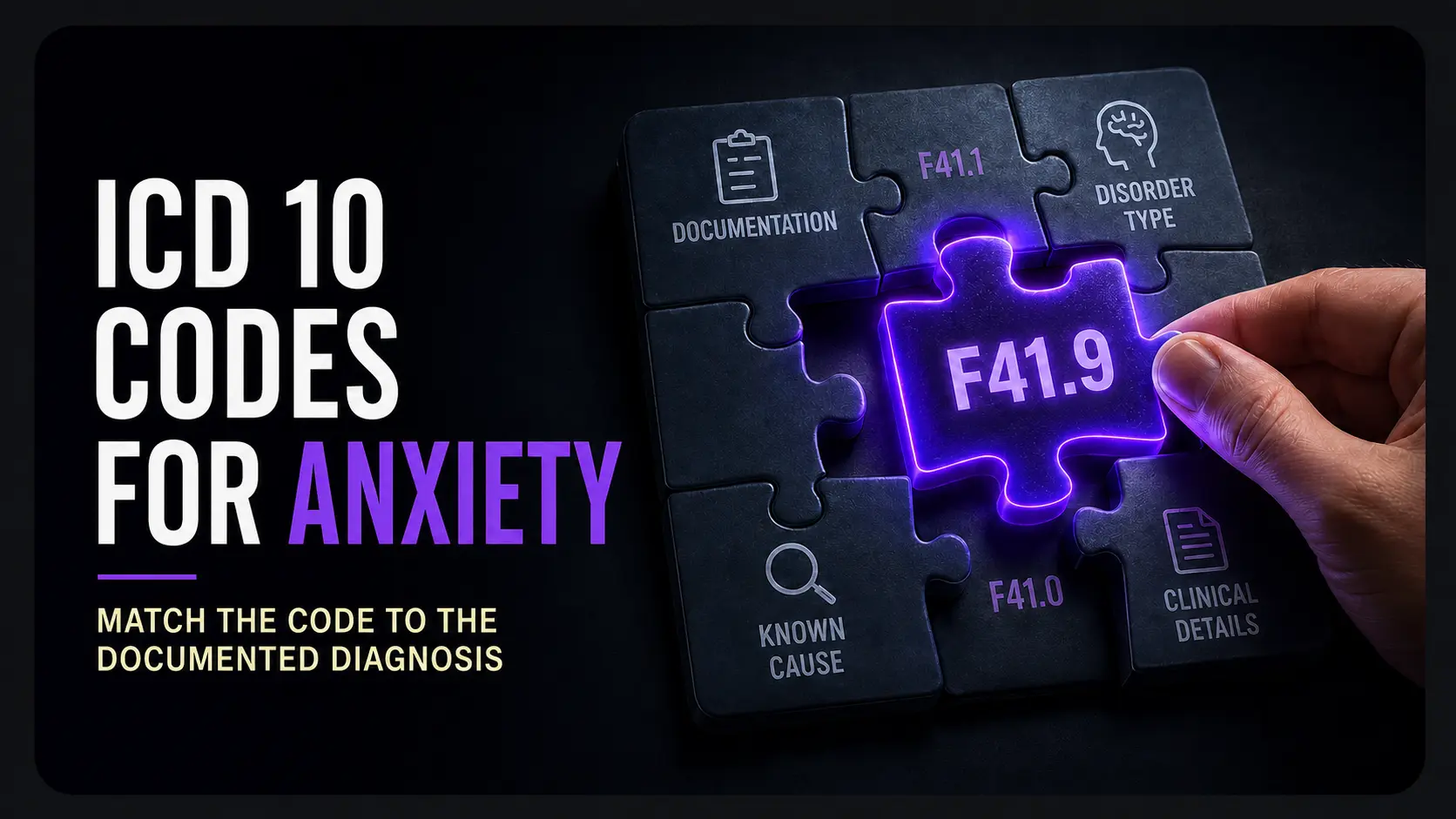
F41.9 is often used when the provider documents an anxiety disorder but does not name a more exact type. It should not replace a more specific code when the record supports one. Codes such as F41.1 for generalized anxiety disorder and F41.0 for panic disorder can give the claim a clearer meaning.
This guide explains common anxiety codes in plain language. It also covers documentation, related conditions, billing risks, and a practical review process. Providers and coding teams should always use the current code set and follow the facts recorded for the patient.
Anxiety is not one code. Match the code to the documented diagnosis.
What Are ICD 10 Codes for Anxiety?
ICD 10 CM is the diagnosis code system used in the United States. It gives healthcare teams a shared way to record diseases, disorders, symptoms, and other reasons for care. The letters and numbers in each code point to a defined condition.
Most common anxiety disorders appear in the F40 and F41 groups. Other anxiety conditions may appear in different groups when they relate to a medical condition, substance use, stress, or another clear cause.
The anxiety ICD 10 code should match the provider assessment. A coder can review the chart and code set, but should not decide which mental health disorder the patient has. That clinical decision belongs to the treating provider.
Why the Exact Anxiety Diagnosis Matters
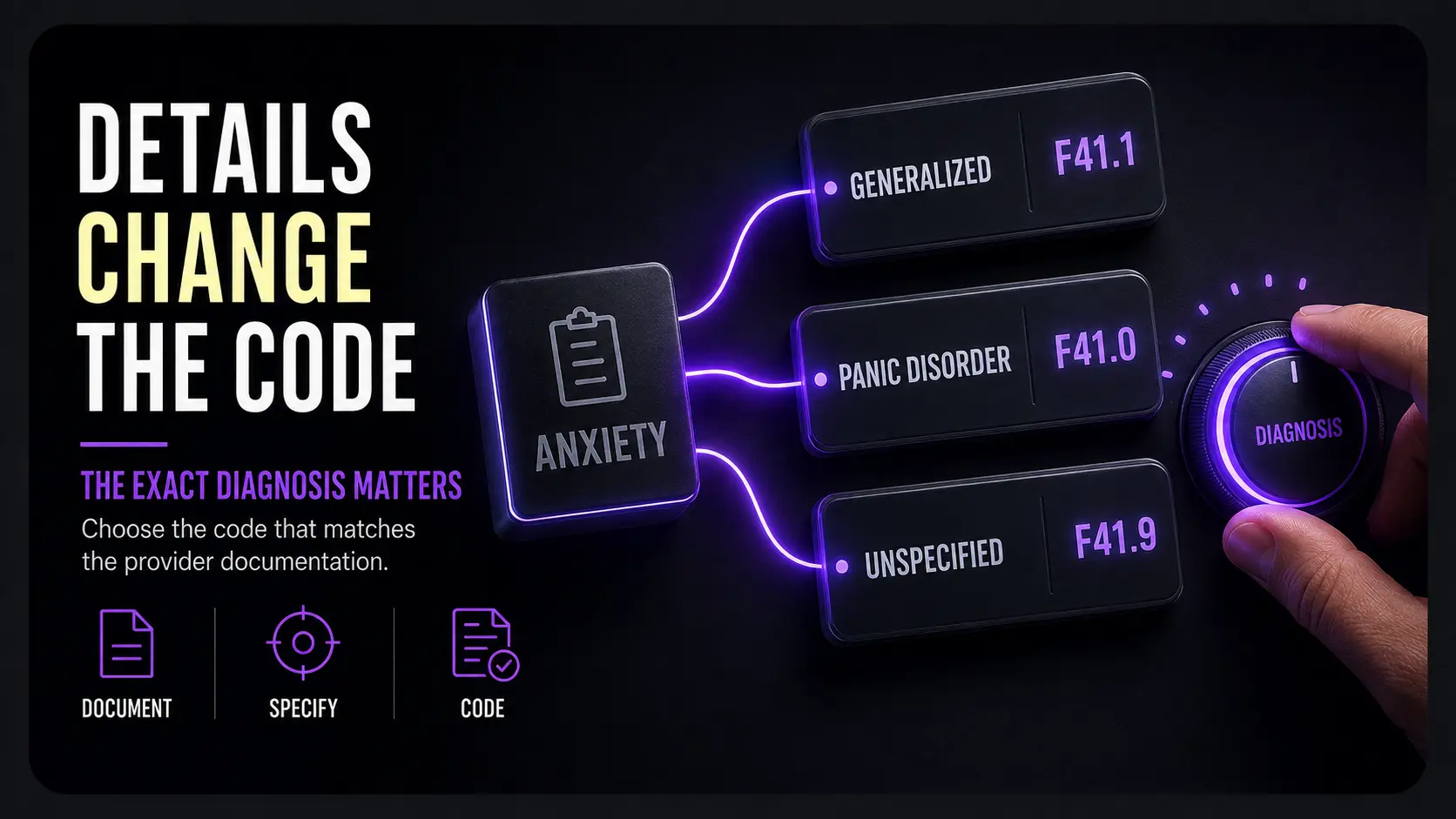
Anxiety is not one single diagnosis. Two patients may both report worry, fear, poor sleep, or a fast heartbeat, yet have different conditions. One may have generalized anxiety disorder while another may have panic disorder or an adjustment disorder.
The exact diagnosis affects the code and may affect coverage for the service. It also helps future care teams understand what the provider found. Clear coding supports a record that follows the patient over time.
When the note contains only the word anxiety, the billing team should read the full assessment. The record may support an unspecified disorder, a symptom, or another confirmed condition. Staff should not add detail that the provider did not document.
F41.9 for Unspecified Anxiety Disorder
F41.9 means anxiety disorder, unspecified. Providers may use this diagnosis when they confirm an anxiety disorder but do not yet identify a more exact type. It can also appear early in an evaluation while the clinical picture is still developing.
The F41.9 code is a full billable diagnosis code, but a valid code does not promise payment. The service must still meet payer rules, and the record must support why the patient needed the visit or treatment.
F41.9 should not become a permanent default when the provider later confirms a specific anxiety disorder. The assessment and problem list should be updated as the diagnosis becomes clearer.
F41.1 for Generalized Anxiety Disorder
F41.1 is used for generalized anxiety disorder. This condition involves ongoing and hard to control worry that affects daily life. The provider should document the diagnosis after a proper clinical assessment.
The generalized anxiety disorder code gives more detail than F41.9. When the provider clearly documents generalized anxiety disorder, F41.1 usually reflects the record better than an unspecified code.
The note should support the diagnosis and care plan. It may describe the patient concern, length of symptoms, effect on daily life, clinical findings, treatment, and follow up. Coding should follow the final assessment, not a screening score by itself.
F41.0 for Panic Disorder
F41.0 describes panic disorder, also called episodic paroxysmal anxiety. Panic disorder involves repeated panic attacks and related concern or changes in behavior. The provider must decide whether the patient meets the clinical requirements.
A single note that mentions panic does not always support panic disorder. A panic attack can occur with other conditions. Coders should use the diagnosis stated by the provider and review any notes about agoraphobia.
When panic disorder and agoraphobia occur together, another code in the phobia group may apply. This is why reading the complete assessment matters before selecting F41.0.
F41.8 for Other Specified Anxiety Disorders
F41.8 means other specified anxiety disorders. It may apply when the provider identifies an anxiety disorder and explains its form, but the condition does not fit another named code in the category.
This code differs from F41.9. Other specified tells the reader that the provider gave detail about the condition. Unspecified means the record does not name the type in enough detail.
Coders should not move from F41.9 to F41.8 only because F41.8 sounds more precise. The provider must document the specified condition that supports the choice.
Codes for Phobias and Social Anxiety
Phobic anxiety disorders appear mainly in the F40 group. These conditions involve strong fear linked to a situation, place, activity, or object. The exact code depends on the diagnosed type.
F40.1 covers social phobias. Agoraphobia codes can show whether panic disorder is present. Specific phobias have more detailed codes, so the team should use the current tabular list and read all required characters.
A general note about fear does not prove a phobic disorder. The provider should name the diagnosis. Coders should also review inclusion notes, exclusion notes, and any added characters before finalizing the claim.
Anxiety Due to a Medical Condition
F06.4 describes anxiety disorder due to a known physiological condition. This code is used when the provider links the anxiety disorder to a documented medical condition.
The link must come from the provider. A coder should not assume that anxiety is caused by a condition simply because both appear in the same chart. The record should state the cause and explain the clinical connection.
Coding may also require the related medical condition, based on official instructions. Teams should review the tabular notes and sequencing guidance for the current year.
Adjustment Disorder With Anxiety
F43.22 describes adjustment disorder with anxiety. It may apply when the provider diagnoses anxiety symptoms as part of an adjustment response to an identified stressor.
This is not the same as an unspecified anxiety disorder. The diagnosis depends on the clinical link to the stressor, the timing, and the provider assessment. Coders should not choose it only because the patient reports a stressful event.
F43.23 describes adjustment disorder with mixed anxiety and depressed mood. When the provider documents this combined adjustment condition, it may better reflect the visit than separate broad symptom codes.
Anxiety Linked to Substance Use
Alcohol, caffeine, medicines, and other substances can cause anxiety symptoms or a substance induced anxiety disorder. These diagnoses use codes from the substance related groups, not a simple F41 code in every case.
The exact code can depend on the substance, pattern of use, and whether the disorder occurs with intoxication, withdrawal, abuse, or dependence. The provider must document these facts clearly.
Coding teams should follow the index and then confirm the code in the tabular list. They should not guess the substance link from a medicine list or test result.
Mixed Anxiety and Depression Coding
Anxiety and depression often appear in the same record. The correct coding depends on whether the provider diagnoses two separate disorders, another specified condition, or an adjustment disorder with mixed symptoms.
Coders should not combine two diagnoses unless the provider states the relationship and the code set supports it. They should also avoid splitting a documented combined condition into separate codes without checking the instructions.
When both conditions meet their own diagnosis requirements, the provider may record each one. The claim should reflect the current assessment and the reason for care.
Documentation That Supports Anxiety Coding
Strong documentation names the anxiety condition in the assessment. It also explains the patient concern, key findings, and effect on daily life. The plan should show how the provider will manage or evaluate the condition.
The note may include medicine management, therapy, safety review, patient education, or follow up when these actions are part of care. A screening tool can support the assessment, but the tool alone does not create a diagnosis.
Xoodoc AI Medical Coding can help teams compare documentation with suggested ICD, CPT, and HCPCS codes. A trained professional should review the result and approve the final code.
How to Choose the Most Accurate Code
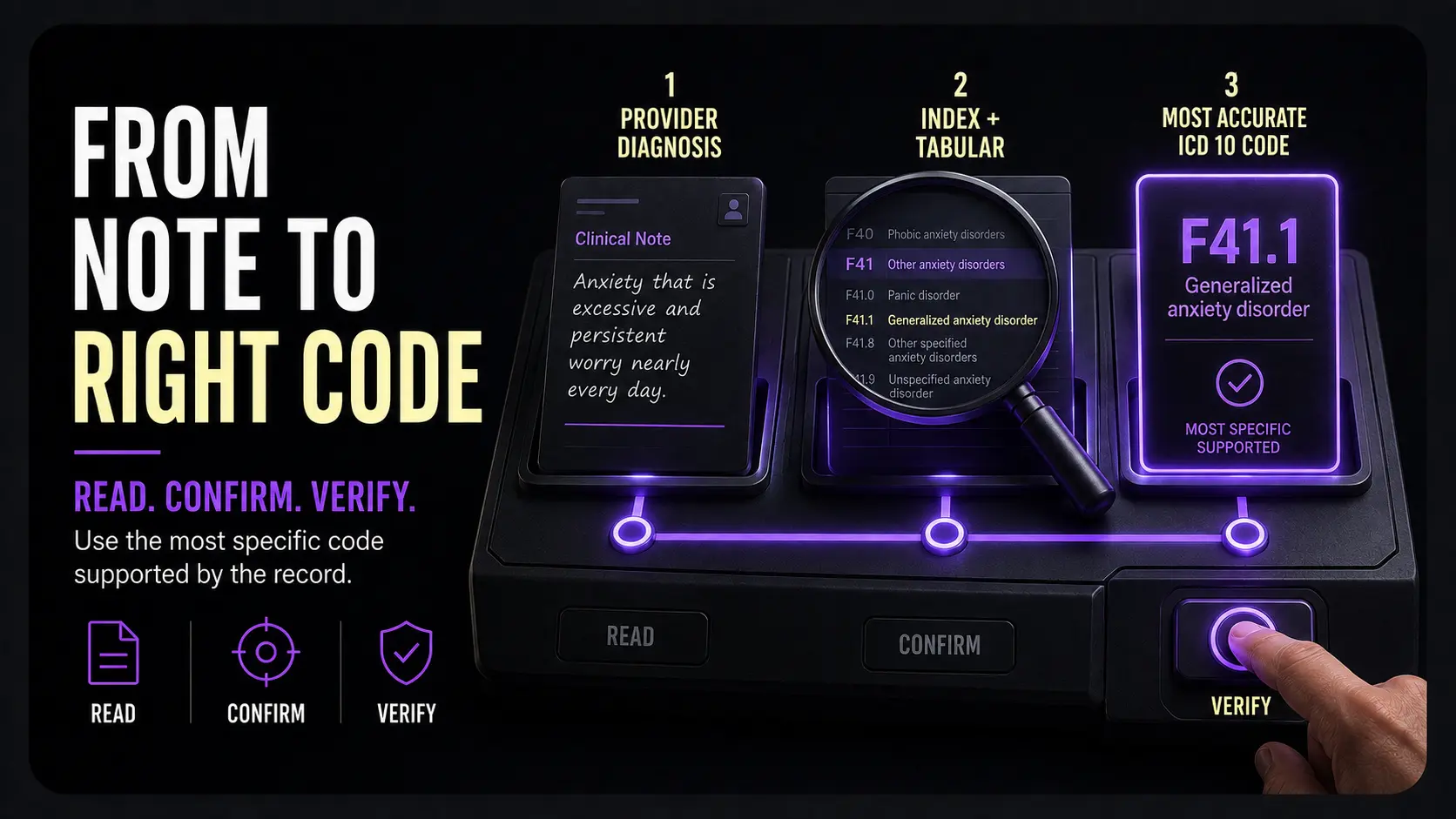
Start with the provider diagnosis, then look up the main term in the official index. After finding a possible code, confirm it in the tabular list. Read every inclusion note, exclusion note, and instruction that applies.
Choose the highest level of detail supported by the record. Do not use a specific code if the provider did not document the needed facts. Do not stay with an unspecified code when the assessment clearly names the disorder.
Check the code set that applies to the date of service. ICD 10 CM updates take effect each October, and some releases may include an added update in April. A saved code list can become old.
Common Anxiety Coding Errors
One common error is using F41.9 for every mention of anxiety. Another is coding a disorder from symptoms without a provider diagnosis. These choices can make the claim and record less accurate.
Teams may also miss a link to a medical condition, substance, stress response, panic disorder, or phobia. Xoodoc Clean Claim Automation can help find coding and documentation gaps before submission.
How Anxiety Codes Support Medical Billing
Accurate diagnosis coding explains why the patient received care and supports payer review. A correct code does not guarantee payment, so the note, service, medical need, and claim must tell the same clear story.
How Xoodoc Supports Coding Review
Xoodoc brings chart details, coding rules, payer checks, and claim data into one review flow. It can identify missing facts, suggest supported codes, and keep source details for human review.
A Simple Claim Review Before Submission
Before submission, confirm the provider diagnosis, code description, date of service, and reason for care. Make sure the current code set applies and that a more exact diagnosis has not replaced an earlier unspecified condition.
Xoodoc Revenue Cycle Automation connects coding, claim checks, denials, and payment work. This helps teams carry the right information from the visit through final payment.
When leaders review denial causes, they can find repeated documentation or coding gaps. Fixing the source can improve future claims and reduce manual work.
The Key Point About Anxiety ICD 10 Coding
The main rule is simple. ICD 10 codes for anxiety must match the diagnosis that the provider documents. F41.9 fits an unspecified anxiety disorder, while a more exact condition may require a different code.
Coders should use the index, confirm the result in the tabular list, and read all notes. They should never create a diagnosis or add detail that is not in the record.
Because the code set changes over time, teams should confirm the code version for the date of service. This protects accuracy and keeps the claim aligned with current rules.
Official ICD 10 CM Reference
For current files and official guidance, review the CDC ICD 10 CM resource. For dates of service from October 1, 2026, use the FY 2027 release and confirm all code details before billing.
Frequently Asked Questions
What is the main ICD 10 code for anxiety?
F41.9 is used for anxiety disorder, unspecified. A different code may apply when the provider documents a more exact condition.
What is the code for generalized anxiety disorder?
F41.1 is used for generalized anxiety disorder when the provider confirms and documents that diagnosis.
What is the code for panic disorder?
F41.0 describes panic disorder. The team should also review whether the provider documents agoraphobia because another code may apply.
What is the difference between F41.8 and F41.9?
F41.8 means other specified anxiety disorders. F41.9 means the anxiety disorder type is unspecified. The provider documentation must support the choice.
Can anxiety be coded from a screening score?
No. A screening score can support an assessment, but the treating provider must diagnose the condition.
When do ICD 10 CM code updates take effect?
Regular yearly updates take effect on October 1. Some years also have an April update. Use the code set that applies to the date of service.