
The 2027 ICD 10 CM updates take effect on October 1, 2026. They add new diagnosis choices, remove outdated entries, revise several titles, and turn some familiar billable codes into parent categories that require a more specific child code.
For coding and billing teams, the update is more than a list of numbers. Every changed code can affect clinical documentation, encoder results, medical necessity checks, payer edits, claim acceptance, reporting, and the way staff search for a diagnosis.
This guide explains the main changes in plain language. It also clears up conflicting code counts found online and gives providers, coders, auditors, and revenue cycle teams a practical plan for a safe October transition.
Table of Contents
ToggleNew codes. New detail. Clean claims start with an early update.
When Do the 2027 ICD 10 CM Updates Take Effect?
The FY 2027 code set applies to patient encounters and discharges from October 1, 2026 through September 30, 2027. The date of service controls which diagnosis code set should be used for a claim.
Teams should not use a new code for a September service only because the claim is sent in October. They also should not keep an old or deleted code for an October service because it remains stored in a template.
This date rule makes testing important. EHR systems, coding tools, claim scrubbers, order sets, charge workflows, reporting tools, and payer edits should all recognize the correct version based on the encounter date.
How Many Codes Changed in the 2027 ICD 10 CM Updates?
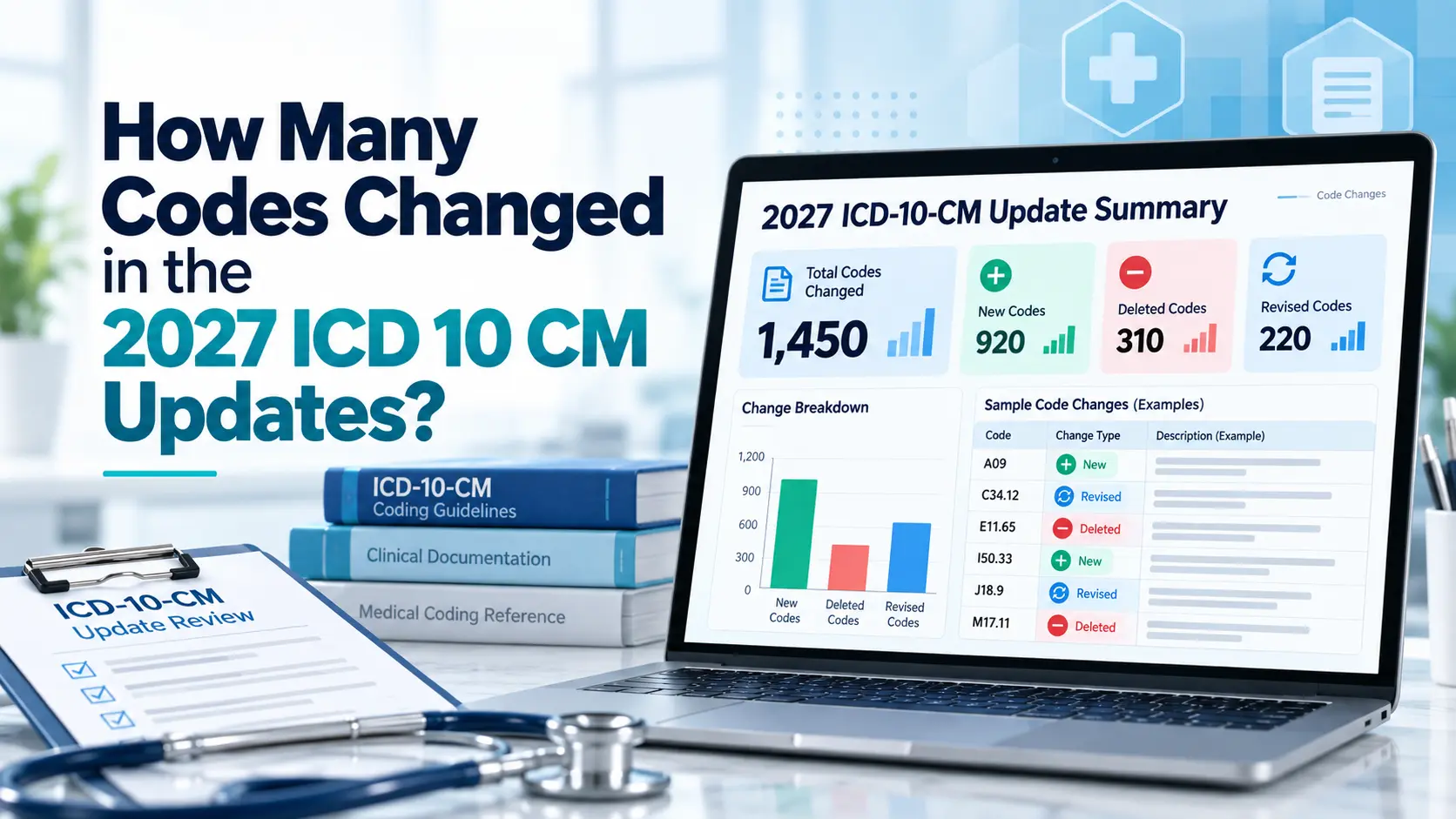
The official final rule claim tables show 190 new reportable diagnosis codes, 30 invalid diagnosis codes, and four revised diagnosis code titles for fiscal year 2027. These numbers describe the claim focused changes most billing teams need.
A wider comparison of the full code description files finds 238 added entries and 21 deleted entries. It also finds 15 codes that remain in the hierarchy but change from billable codes to nonbillable parent categories.
Both views can be correct because they count different things. The safest approach is to review additions, invalid codes, revised titles, and billable status changes instead of relying on one headline total.
Why Different Sources Show Different Totals
Some sources say there are 190 new codes because they count new codes that are valid for claim submission. Other sources report 238 additions because they also count new categories, headers, and other entries in the full file.
The deletion totals differ for a similar reason. A code that disappears from the full file is deleted. A code that remains visible but can no longer be submitted is not deleted, yet it can still cause a claim rejection.
This distinction matters during staff education. A search tool may still display a familiar parent code, but the coder must select a more detailed child code when that parent loses its billable status.
Major 2027 ICD 10 CM Updates by Clinical Area
The new ICD 10 codes 2027 release adds detail across neoplasms, blood disorders, endocrine conditions, circulatory disease, respiratory disease, digestive disease, musculoskeletal conditions, pregnancy, congenital and genetic disorders, injuries, and health history factors.
The largest groups of reportable additions appear in injury and toxic effect coding, pregnancy coding, and musculoskeletal coding. These areas deserve focused testing because they contain new choices that depend on clinical detail.
The update also changes instructions in the Alphabetic Index and Tabular List. Coders should read inclusion terms, exclusion notes, code first directions, code also directions, and additional code notes instead of choosing a code from its title alone.
New Cardiomyopathy and Arrhythmia Detail
Dilated cardiomyopathy gains more detail. I42.0 becomes a nonbillable parent, while I42.00 identifies an unspecified type, I42.01 identifies familial genetic dilated cardiomyopathy, and I42.09 covers other dilated cardiomyopathy.
Other cardiomyopathy and cardiac arrhythmia families also expand. New choices distinguish arrhythmogenic cardiomyopathy, Brugada syndrome, ventricular bigeminy, and other specified conditions that were previously grouped under broader codes.
Providers should document the confirmed type and cause when known. A note that only says cardiomyopathy or arrhythmia may not support the new level of detail, which can lead to an unspecified code or a query.
New Genetic Disorder Codes Related to Cancer
Chapter 17 now includes genetic disorders in its title and adds a new group for genetic disorders linked with neoplasms. The expansion provides dedicated choices for conditions such as Lynch syndrome and certain inherited cancer syndromes.
New codes also cover familial cancer syndromes involving pathogenic BRCA1 or BRCA2 changes and Li Fraumeni syndrome. Related instructions may call for another code for active cancer, personal history, or genetic susceptibility when applicable.
Coders should not assign a genetic condition from family history alone. The provider record must support the patient diagnosis, and any added history or cancer code must follow the Tabular List instructions for the selected condition.
More Detail for Pregnancy Coding
Pregnancy coding receives many new choices. Ectopic pregnancy categories gain more site detail, including interstitial, cesarean scar, and cervical locations, with distinctions based on whether an intrauterine pregnancy is also present.
The update also adds choices for continuing pregnancy after vanishing twin syndrome. These codes can depend on trimester and the fetus involved, so the note must clearly identify the facts needed for final code selection.
Obstetric coding already depends on close review of sequencing and trimester rules. Teams should update templates and education so clinicians capture location, laterality, trimester, fetus, and other required details at the time of care.
Musculoskeletal Codes Gain Specificity
Musculoskeletal updates add useful detail for plantar fasciitis and plantar fascial fibromatosis. The conditions move into clearer code families, with new choices that can identify the right foot, left foot, or an unspecified side.
Other osteomyelitis codes also expand by site and laterality. Several old codes become nonbillable parents, which means a coder must choose the new right, left, or unspecified child code for claim submission.
This change shows why documentation and software must move together. An encoder can display the new choices, but it cannot safely select a side that the clinician did not record.
New Respiratory and Endocrine Codes
New respiratory choices include odontogenic sinusitis by sinus location. The code family can distinguish maxillary, ethmoid, frontal, sphenoid, and unspecified sites, helping the diagnosis show that the sinus condition began from a dental source.
Endocrine updates include codes for post bariatric hypoglycemia and other postprocedural hypoglycemia. Instructions can require an additional code for the hypoglycemia level, so the full Tabular List must be reviewed.
Other additions address secondary malignant neoplasms at more specific respiratory sites and selected blood or digestive conditions. Specialty teams should filter the official files to find the changes most likely to affect their own services.
Injury and Toxic Effect Codes Change
A large part of the update concerns injuries and toxic effects. The code set rebuilds the family for toxic effects of other organic solvents and creates more detailed choices for specific agents, intent, and encounter type.
New toxic effect options include separate families for certain chemicals and drugs. These codes may require documentation of the exact substance, whether the event was accidental or intentional, and whether the encounter is initial, subsequent, or a sequela.
Never map an old code to a new residual code without reviewing the record. The updated family may now provide a specific choice for the documented substance, and the official conversion table should guide system mapping.
New History and Exposure Codes
New Z codes add detail for certain military and environmental exposures, including burn pits, Agent Orange, and levels of blast overpressure. Other changes add or refine history codes used to describe important patient background.
The adult low body mass index code also becomes more specific. Z68.1 changes into a parent, with new child codes separating a body mass index of 18.4 or less from a body mass index of 18.5 through 19.9.
History and exposure codes should not replace an active diagnosis. Coders must understand whether the note describes a current condition, an exposure, a personal history, a family history, or a risk factor.
Revised Code Titles and Guideline Changes
Only four diagnosis code titles are revised, but title changes can still affect search results, reports, staff training, and payer logic. Update code descriptions wherever staff view or select diagnoses.
Guideline revisions include wording for hypertension with heart disease and resistant hypertension. Chapter 17 guidance now reflects genetic disorders, while Chapter 21 adds guidance involving family history and personal risk from diethylstilbestrol exposure.
The yearly guidelines remain essential even when changes look small. A code can stay the same while its instructions, sequencing, inclusion terms, or exclusion notes change the correct way to report it.
Deleted Codes Versus Nonbillable Parent Codes
A deleted code no longer appears in the active code set for the effective period. An invalid claim code may be deleted, replaced, expanded, or no longer accepted for another reason shown in the official files.
A nonbillable parent remains in the code hierarchy to organize more specific child codes. Examples for FY 2027 include I42.0, I42.8, I49.8, M72.2, Z68.1, and several osteomyelitis parents.
Update favorites, problem list shortcuts, templates, and saved billing rules before October 1. A familiar parent code can look correct to a user while still failing the claim validity check.
Why Documentation Must Change Too
The FY 2027 ICD 10 codes often ask for more detail about cause, site, side, timing, trimester, fetus, substance, intent, or encounter. Clinical notes must contain the facts that separate one new code from another.
Coding leaders should identify high use families that gained new children and share short documentation prompts with clinicians. The prompt should help capture missing facts without pushing a diagnosis or encouraging copied language.
How the Updates Affect Claims
The ICD 10 coding changes can affect claim edits, medical necessity rules, prior authorization records, quality reporting, risk models, dashboards, and contract reports. A code set update should therefore involve more than the coding department.
Prepare for the 2027 ICD 10 CM Updates
Start sixty to ninety days before the effective date. Load the official files into a test system, confirm the version date, and check that every connected vendor can process the updated codes.
How Xoodoc Can Support the Transition
Next, compare recent diagnosis use against deleted and newly nonbillable codes. Focus education on specialties with high volume changes, then test sample encounters across documentation, coding, authorization, claims, and reporting.
Before launch, remove outdated favorites, update templates, review payer notices, train staff, and create a clear help path. After October 1, monitor invalid code rejections, unspecified code use, coder queries, and denial trends daily.
Xoodoc can help teams prepare through AI medical coding that supports accurate code selection while keeping the clinical record and human review at the center of each decision.
Final Coding Checklist
Pair coding preparation with automated insurance eligibility verification and automated prior authorization so updated diagnoses move through early revenue cycle steps with fewer repeated checks.
On launch day, confirm the active code set in every system and give staff one place to report a missing code or unexpected edit. Fast issue routing can prevent the same problem from reaching many claims.
Keep the official addendum and guidelines available during review. Check high volume code families first, confirm documentation supports the final choice, and never replace a deleted code through guesswork or an unverified crosswalk.
Official FY 2027 Files
A connected healthcare revenue cycle automation process can help teams track rejections and denials after launch. Review the official CMS ICD 10 files for the current addendum, tables, index, conversion file, and coding guidelines.
Frequently Asked Questions
When do the FY 2027 ICD 10 CM codes take effect?
They take effect October 1, 2026 and apply to patient encounters and discharges through September 30, 2027.
How many new diagnosis codes are there for FY 2027?
Official claim tables show 190 new reportable diagnosis codes. A full code file comparison shows 238 added entries because it also counts categories, headers, and other nonbillable entries.
How many codes were deleted or made invalid?
Official claim tables list 30 invalid diagnosis codes. A full file comparison finds 21 deleted entries plus 15 codes that remain as nonbillable parent categories.
Can a provider use a new code before October 1, 2026?
No. Select the code set that applies to the patient encounter date. Do not use an FY 2027 code for a service that occurred before the effective date.
What happens when a code becomes nonbillable?
The code may remain as a parent in the hierarchy, but it cannot be submitted on a claim. The coder must select a valid and more specific child code supported by the record.
Where can coding teams download the official files?
CMS provides the code descriptions, addendum, tables, index, conversion table, present on admission exempt list, and official coding guidelines on its ICD 10 page.